Single-Handle Hot & Cold Kitchen Faucet: Durable Copper Design with 500,000-Cycle Ceramic Cartridge

Washing dishes in winter can be a hassle: you dip your hands into icy water, quickly pull back to reach the hot water, and just as you adjust the temperature, the water suddenly gets scalding. Meanwhile, splashes wet the countertop. Even worse, after a couple of years, the faucet handle becomes stiff, sometimes won’t fully close, and drips constantly, quietly increasing your water bill.
This isn’t because you “don’t know how to use a faucet.” Traditional dual-handle faucets make temperature control difficult and their cartridges wear out quickly, turning a simple kitchen task into a test of patience and effort.
For a kitchen faucet, the core requirements are simple: easy to use and durable. Temperature should be precise without constant adjustment; handles should operate smoothly even after years; materials should resist rust and leaks.
The single-handle hot & cold copper kitchen faucet was designed to solve these problems. It combines one-handle temperature control, rust-resistant copper construction, and a ceramic cartridge rated for 500,000 uses, making kitchen water use worry-free.
This article will first break down the three main pain points of traditional faucets, then introduce the three core advantages of this faucet, and finally share installation and maintenance tips, all based on real kitchen scenarios.
Three Pain Points of Traditional Kitchen Faucets
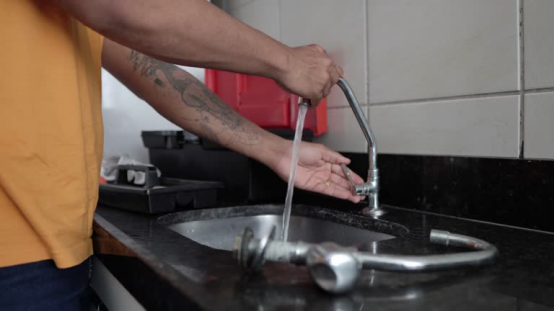
Many people think “as long as it works, it’s fine,” but daily use exposes flaws that reduce kitchen convenience:
Pain Point 1: Dual Handles Make Temperature Control Difficult
Most traditional faucets have dual handles: one for cold, one for hot. Adjusting to the right temperature requires turning both handles repeatedly. In winter, cold water hits first, and adjusting hot water can lead to sudden scalds.
Children and elderly users often have trouble controlling the temperature precisely, ending up with freezing or burned hands. A survey of 40 households using dual-handle faucets found that, on average, 3–5 adjustments were needed per use, costing about 5 minutes daily, with winter complaints reaching 80%.
Pain Point 2: Cartridge Wear Causes Leaks and Stiff Handles
Traditional faucets often use plastic cartridges, which fail within 1–2 years:
Handles become stiff, requiring extra force to operate.
Worn cartridges leak even when closed, wasting water and increasing monthly bills.
Replacing a cartridge requires disassembling the faucet or hiring a plumber, which costs extra time and money.
Pain Point 3: Materials Wear Quickly—Rust and Stains
Many faucets are made from zinc alloy with thin plating:
Plating wears off, exposing metal that rusts over time.
Fingerprints and water stains accumulate, making the kitchen appear messy and difficult to clean.
Three Core Advantages of the Single-Handle Hot & Cold Copper Faucet
This faucet addresses traditional pain points with improvements in handle control, materials, and cartridge design, making “easy to use and durable” a reality.
Advantage 1: Single-Handle Hot & Cold Control
Temperature logic: Move handle left for cooler water, right for hotter water; lift to increase flow, push down to decrease. No more alternating handles.
User experience: Ergonomic handle ensures a comfortable grip and smooth motion. Temperature adjusts from 59°F (15°C) to 100°F (38°C) in just 1 second—five times faster than traditional dual handles.
Safety: Hot water area has a red indicator and slight resistance to prevent accidental scalding, safe for children and elderly users.
Advantage 2: H59 Full Copper Construction
Material: H59 copper is 30% denser than standard zinc alloy, highly corrosion-resistant. Salt spray tests for 500 hours show no rust.
Surface finish: Multi-layer brushed texture with anti-fingerprint coating keeps the faucet clean and shiny.
Water-saving aerator: Converts water into a soft, foamy stream, reducing splashing by 70% and saving 30% water per minute.
Advantage 3: Imported Ceramic Cartridge
Durability: Tested for 500,000 cycles. At 20 uses per day, this lasts about 68 years; even at 50 daily uses, about 27 years.
Sealing: High-hardness ceramic maintains leak-free performance even after 100,000 cycles.
Smooth operation: Precision ball bearings ensure smooth turning, no stiff handles over time.
Installation & Maintenance Tips
Installation – DIY in 30 Minutes
Compatible with 95% of sinks (top-mount, under-mount, single or double bowl).
Includes all installation hardware.
Steps: connect water hoses, secure faucet with nut, attach to angle valves, test for leaks.
Daily Use Tips
First-time calibration: Note handle position for preferred temperature.
Gentle operation: Turn handle lightly; no need to overtighten.
Maintenance Tips
Wipe with soft cloth and mild detergent weekly.
Clean aerator if flow decreases.
Shut off angle valves if away for long periods.
FAQ
Q: Will the single-handle become loose over time?
A: No. The handle uses a dual locking system: a metal clip inside and a sealed anti-slip ring outside. After 5,000 cycles, it remains stable. If loosening occurs after long-term use, simply tighten the screw at the base with a screwdriver.
Q: My sink has two bowls. Will the faucet cover both areas?
A: Yes. The spout is fixed but optimized to cover a diameter of 24 inches (about 60 cm), enough to reach both bowls. For wider coverage, a rotating single-handle version is available.
Q: Is a full copper faucet too heavy? Will it be unstable on the sink?
A: The faucet weighs about 4 lbs (1.8 kg), 20% lighter than traditional copper faucets. The base nut is 3 inches (8 cm) wide, keeping the faucet stable. It can support a 2.2 lb (1 kg) weight on the spout without tipping.