Small Kitchen Space Hack: Maximize Your Sink Area with Rotating or Pull-Down Kitchen Faucets

In compact kitchens, the real challenge often hides in the sink area—narrow countertops (often less than 60 cm) and small sinks (single or mini double bowls) make washing large cookware like woks and soup pots frustrating. Traditional fixed faucets cover only a limited area, forcing you to maneuver pots repeatedly while juggling cleaning supplies like sponges and dish soap.
The solution? Choosing the right kitchen faucet. A rotating faucet provides 360° coverage across the sink and countertop, while a pull-down faucet extends water flow beyond the sink. Together, they act as “space magicians,” making a small sink area feel much larger without remodeling. This guide explores common small kitchen sink issues, details the advantages of rotating and pull-down faucets, and provides practical buying tips using high-quality products (see rotating faucet and single-handle pull-down faucet).
Common Small Kitchen Sink Frustrations and How the Right Kitchen Faucet Solves Them
Compact kitchens (≤6㎡) often struggle with “tight space + rigid tools,” leading to three main frustrations. Ordinary fixed faucets amplify these problems, while rotating or pull-down kitchen faucets solve them efficiently:
1. Limited cleaning coverage: large pots hard to wash, splashes everywhere
Single sinks (35–45 cm) or mini double sinks (≤50 cm) cannot accommodate fixed faucets that reach only 1/3 of the sink. Washing a wok requires lifting and tilting repeatedly, splashing water across the countertop. A rotating kitchen faucet swivels left and right, and a pull-down faucet extends water flow, covering 2–3 times more area. Pots, pans, and utensils can be cleaned without moving them, and splashes are reduced.
2. Countertop clutter: faucet base takes space, supplies get in the way
Traditional faucets occupy 5–8 cm of valuable countertop space. Soap, sponges, and draining racks often crowd the remaining area. Rotating faucets usually feature a single-handle design (example) with compact bases (≤12 cm diameter), freeing space for small storage. Pull-down faucets fold neatly against the wall, leaving extra countertop room for essentials.
3. Inefficient workflow: wash-cut-rinse cycles feel chaotic
Small kitchens often position sinks close to prep areas. Fixed faucets limit washing to the sink only, forcing multiple trips for rinsing vegetables or cutting boards. Rotating faucets pivot across the countertop, and pull-down faucets let you rinse prep areas directly, improving workflow and saving half the time.
Choosing the Right Kitchen Faucet for Your Small Sink
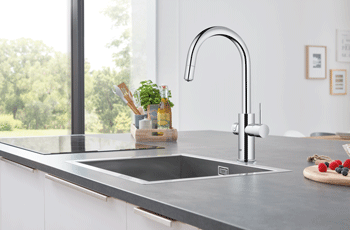
Different sink types and usage needs determine the ideal faucet. Here’s a breakdown:
1. Rotating Kitchen Faucets: 360° Coverage for Small Sinks
- Core benefit: No dead spots; ideal for mini sinks and narrow countertops.
- Example: A 360° rotating faucet covers the entire sink and countertop, allowing you to wash a 40 cm wok or rinse spills without moving items.
- Design advantage: Single-handle operation lets you adjust water flow and temperature with one hand.
- Best for: Single sinks (35–45 cm) or mini double sinks (45–55 cm), frequent large cookware washing, narrow counters.
2. Pull-Down Kitchen Faucets: Flexible Reach for Small Spaces
- Core benefit: Extendable spout reaches beyond the sink for versatile cleaning.
- Example: Pull-down kitchen faucet with 60–80 cm hose, dual spray modes (“spray” for veggies, “stream” for pots), covers prep areas and sinks alike.
- Best for: Single sinks (40–50 cm) or small double sinks (55–60 cm), frequent food prep, washing long-handled tools, and high-traffic kitchens.
Maximizing Efficiency: 3 Tips for Small Kitchen Faucet Use
- Install at the right height
- Rotating faucets: 30–40 cm above sink, spout 20–25 cm from sink bottom.
- Pull-down faucets: 35–45 cm high; ensure hose retracts smoothly without tangling.
- Consider low-profile models (example) to avoid hitting upper cabinets.
- Zone your sink
- Left rotation: wash veggies with a small strainer.
- Right rotation: clean cookware and dishes.
- Pivot to countertop: rinse spills, creating a “cleaning auxiliary zone.”
- Optimize storage around the faucet
- Leave 5–8 cm for wall-mounted sponge holders.
- Use a foldable draining rack near the sink to keep dishes off the limited counter space.
Avoiding Common Mistakes When Buying a Small Kitchen Faucet
- Only focus on rotation/pull-down: check spout diameter (18–20 mm recommended for mid-low water pressure).
- Oversized pull-down hoses: hoses >100 cm can clutter space; stick to 60–80 cm.
- Ignoring installation type: measure sink holes (single vs three-hole) to avoid unnecessary countertop modifications.
DIY Installation: 2 Steps for Small Kitchen Faucets
- Remove the old faucet: turn off the water, disconnect the hoses, and unscrew the mounting nuts.
- Install a new faucet: insert hoses through holes, tighten mounting nuts, connect hot/cold water, test for leaks, and seal base with silicone.
Conclusion
The right kitchen faucet acts as a “space magician” in compact kitchens. Rotating faucets cover every corner of the sink, while pull-down faucets extend to prep areas, making small sinks functional, efficient, and uncluttered. Products like the rotating kitchen faucet and single-handle pull-down faucet are designed for small kitchens, combining practicality, flexibility, and minimal footprint.
For small kitchen users, bigger isn’t better—flexibility is. A well-chosen kitchen faucet transforms cramped sinks into highly functional spaces, letting you cook, clean, and prep with ease.