Accessible Kitchen Essentials: High-Angle Swivel Kitchen Faucets for Wheelchair Users

The kitchen is the heart of household life, but for wheelchair users, traditional kitchen faucets often present operational challenges. Fixed or low-rotation faucets may not accommodate seated height or limited reach, making tasks like filling containers, washing vegetables, or cleaning dishes cumbersome. Users may need to stretch, lean, or even request assistance, reducing independence and efficiency. High-angle swivel kitchen faucets, designed with “flexible rotation and adjustable height,” provide a key solution for accessible kitchens, allowing wheelchair users to perform daily tasks with ease and autonomy.
Three Core Operational Challenges for Wheelchair Users in the Kitchen
1. Limited Rotation in Traditional Kitchen Faucets
Most traditional kitchen faucets rotate only 90°–120° or are fixed on one side of the sink. For wheelchair users:
Arm mobility is constrained by seating height. If the faucet cannot reach the center or different areas of the sink, users must stretch or reposition their wheelchair, which can be tiring and increase collision risk.
Washing larger pots and pans becomes inefficient, as a low-rotation faucet cannot cover the entire sink, requiring repeated repositioning of items.
2. Poor Height and Handle Accessibility
Conventional kitchen faucets are often designed for standing users:
Low spouts can be blocked by the wheelchair or body, causing splashing, while high or distant handles require awkward stretching, potentially causing shoulder or arm strain over time.
Some faucets require two-handed operation or stiff knobs, making single-handed use difficult and limiting independence.
3. Hard-to-Clean Areas
Fixed structures or low-rotation kitchen faucets create hygiene challenges:
Dead spots where the faucet meets the sink are difficult for wheelchair users to reach, leading to accumulated grease and limescale.
Repairs, such as leaks, are more challenging due to fixed structures, often requiring external assistance.
Four Accessibility Advantages of High-Angle Swivel Kitchen Faucets
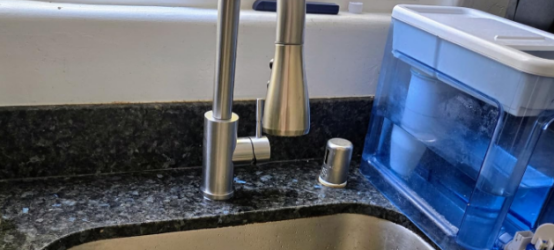
1. Wide Rotation Coverage
High-angle swivel kitchen faucets offer 180°–360° rotation:
Users can easily position the spout in front, left, or right without moving the wheelchair, allowing natural arm extension and reducing fatigue.
Cleaning large cookware is more efficient, as the spout can hover directly over the item, improving operation speed by over 50%.
2. Height and Handle Designed for Seated Use
Accessible kitchen faucets are designed with seated users in mind:
Spouts are typically 8–12 inches above the sink, with adjustable angles to prevent splashing.
Single-handle designs are positioned lower and engineered for lightweight operation, allowing one-handed control of flow and temperature, enhancing independence.
3. Flexible Water Flow Modes
Many high-angle swivel kitchen faucets provide multiple flow options:
Stream mode for quick filling or transferring water.
Spray mode for gentle rinsing of fruits, vegetables, or the sink surface.
Pull-out sprayers extend reach to clean countertops or areas around the wheelchair, further expanding usability.
4. Easy Cleaning and Maintenance
Accessible kitchen faucets minimize hygiene dead zones:
Smooth surfaces with minimal gaps reduce grime accumulation, enabling easy wipe-down.
Removable aerators allow single-handed cleaning without tools, maintaining performance with minimal effort.
Key Selection Criteria for High-Angle Swivel Kitchen Faucets
1. Rotation and Flexibility
Choose kitchen faucets clearly labeled as 360° swivel or large-angle rotation, ensuring smooth, resistance-free movement (testing in-store is recommended).
Check base stability; heavier bases or threaded fixtures prevent wobbling during rotation.
2. Operational Convenience
Single-handle kitchen faucets allow one-handed control over water flow and temperature.
Lightweight knobs requiring less than 1 lb (≈5 N) of force make operation effortless.
Touchless kitchen faucets further improve accessibility, enabling users to activate water with a simple gesture.
3. Material and Durability
Solid brass bodies with chrome or matte finishes resist corrosion and scratching.
Silicone aerators prevent limescale buildup and are easy to clean.
Ceramic cartridges ensure long-term sealing and reduce maintenance frequency.
Two Extended Applications for Accessible Kitchens
1. Sink Integration
High-angle swivel kitchen faucets work best with deep, large sinks (≥8 inches deep).
Countertops should accommodate a seated height of 31–33 inches; under-mount sinks may reduce operating height further, improving comfort.
2. Auxiliary Accessories
Non-slip mats prevent dishes or utensils from sliding during use.
Wall-mounted racks positioned below 4 ft allow convenient one-handed access to cleaning tools, minimizing bending or stretching.
For a wide selection of accessible kitchen faucets, including 360° swivel, single-handle, and pull-out sprayer designs, visit this product page, which caters to wheelchair users and supports accessible kitchen renovations.
Common Questions
Can wheelchair users operate high-angle kitchen faucets independently? Yes, with single-handle or touchless models, users can control water flow and temperature comfortably.
Are pull-out sprayers essential? They enhance reach and flexibility, especially for cleaning around the wheelchair or countertop edges.
How do these faucets compare to traditional models in maintenance? Smooth designs with removable aerators reduce cleaning difficulty and allow single-handed maintenance.
User Experience
Wheelchair users report improved efficiency and comfort with high-angle swivel kitchen faucets. Tasks that previously required assistance or awkward movements can now be performed independently, enhancing confidence and quality of life.
Summary: Elevate Accessibility with High-Angle Swivel Kitchen Faucets
An accessible kitchen empowers everyone to work independently and safely. High-angle swivel kitchen faucets, with flexible rotation, height adjustment, and ease of operation, become essential tools for wheelchair users. Choosing the right model addresses daily challenges in water access, cleaning, and hygiene, transforming the kitchen into a truly accessible and welcoming space.